Oregon Fly Fishing Shows: The timing is about right. It's late in the winter steelhead run, early in the spring trout season. Sure there are fish biting somewhere, but it's snowing and the water is high.
Back on February 17-18, 2007, The Fly Fishing Show came to Portland, OR at the Oregon Convention Center. Chester Allen, a writer for The Olympian, had a great write up of the event.
From the article: "Hordes of fly anglers herded themselves right into the Oregon Convention Center and forked over 24 bucks for two days inside a building that has all the charm and intimacy of an international airport."
That show has come and gone, but the new show on the block is around the Corner. The Northwest Fly Tyers and Fly Fishing Expo 2007 is going to be March 9 and 10 at the Linn County Expo Center in Albany, Oregon. It's run by the same group that put on the Fly Tyer's expo in Eugene in previous years.
The NW Fly expo is being put on by the Federation of Fly Fishers. Oregon Outdoor Journal will be on premises at the event, volunteering to run a booth for Eugene Trout Unlimited Chapter 678.
We'll have a full report from the show right here.
Also, I'm headed to Houston and Orlando this week -- talking about energy efficiency and technology. But not much about the Oregon Outdoors. But if something comes up, I'll post.
Wednesday, February 28, 2007

Monday, February 26, 2007
Oregon Wildlife frolics in Columbia Gorge
Driving back from Eastern Washington today, we came over on 84 West, through the Columbia River Gorge. As we were driving, I spotted my first herd of Oregon bighorn sheep, halfway up a cliff just a few miles east of the mouth of the John Day River. Here are some Oregon Bighorn Sheep Links:
Bighorn sheep in Hell's Canyon
Foundation for North American Wild Sheep
Oregon Bighorn Sheep statistics

Speaking of bighorns: If you're looking for an amazing, lyrical book about wildlife management, wild animals and our relationship to the wilderness, I highly reccomend Ellen Meloy's Eating Stone.
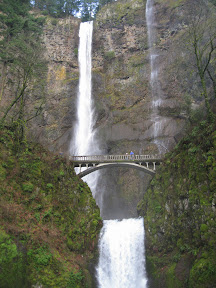
After that, KP and I stopped by Multnomah Falls and took the obligatory shot you see below:
Then on the way out of Multnomah Falls we saw a bald eagle, right on the side of 84. Maybe Steven Jr?
Speaking of bighorns: If you're looking for an amazing, lyrical book about wildlife management, wild animals and our relationship to the wilderness, I highly reccomend Ellen Meloy's Eating Stone.
After that, KP and I stopped by Multnomah Falls and took the obligatory shot you see below:
 |
| From MattStansberry |
Then on the way out of Multnomah Falls we saw a bald eagle, right on the side of 84. Maybe Steven Jr?
Sunday, February 25, 2007
Oregon Cascades Snowshoeing: Highway 242
My buddy Peter Green, chairman of trail maintenance for the Obsidians, sent OOJ these photos from a recent snowshoeing trip up McKenzie Pass -- Highway 242.
The route was 14 miles round trip from the snow gate on the Sisters side of 242. Peter and his wife Monica camped on Feb 2, woke up the next day, and hiked to the summit of McKenzie Pass in about 3 hours.
They camped out in the Dee Wright Observatory. Peter had never heard of anyone camping in that shelter before, but thought it seemed like a good idea. They actually had to set up the tent inside because it was pretty wet and icy. But it was a great wind block. Lots of mice, so secure your food if you go.
Check out our audio-cast on snowshoeing with Peter Green of the Obsidians: Download MP3.
The route was 14 miles round trip from the snow gate on the Sisters side of 242. Peter and his wife Monica camped on Feb 2, woke up the next day, and hiked to the summit of McKenzie Pass in about 3 hours.
They camped out in the Dee Wright Observatory. Peter had never heard of anyone camping in that shelter before, but thought it seemed like a good idea. They actually had to set up the tent inside because it was pretty wet and icy. But it was a great wind block. Lots of mice, so secure your food if you go.
Check out our audio-cast on snowshoeing with Peter Green of the Obsidians: Download MP3.
Deschutes River February hike
Lower Deschutes River Hike: KP and I headed east today, on our way to Richland, Wash. (on a road trip for the day job). It was our first time through the Columbia River Gorge area. That drive gives you perspective on the lay of the water in our state, passing over the mouth of the Deschutes and the John Day.
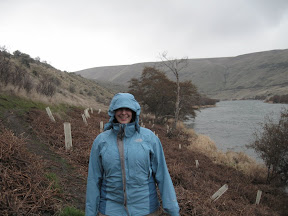
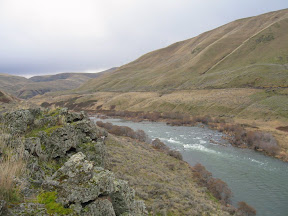
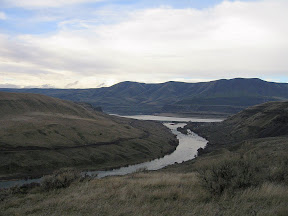
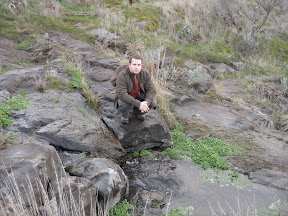
We stopped at the Deschutes River State Recreation Area to do the first hike in Bill Sullivan's hiking guide to Eastern Oregon. It was a 4.2 mile loop, 600 feet elevation gain.
It offered some great photo opportunities, a sense of geography, and a good place to fish.
We stopped at the Deschutes River State Recreation Area to do the first hike in Bill Sullivan's hiking guide to Eastern Oregon. It was a 4.2 mile loop, 600 feet elevation gain.
It offered some great photo opportunities, a sense of geography, and a good place to fish.
 |
| From MattStansberry |
 |
| From MattStansberry |
 |
| From MattStansberry |
 |
| From MattStansberry |
Saturday, February 24, 2007
Zumbo anti-assault rifle blog fuels gun nut hysteria
Zumbomania is causing a shitstorm. Former Outdoor Life columnist Jim Zumbo was unceremoniously canned this week for writing negatively about assault rifles in hunting situations.

I’m not a gun nut, but I own three that I hunt with -- 12 gage shotgun, .22 and a bolt action 7mm. I’m probably buying a handgun before I start doing much more predator calling in cougar country. And I tend to agree with Zumbo and Field & Stream’s David Petzl (more or less), that the AK-class rifle doesn’t have a place in the hunting community.
Sure, you should be able to have them, shoot them, store a bunch in the armory at your compound -- be ready for the rapture! But I don’t think they have a place in fair chase hunting.
I lived in Massachusetts for a year; I know excessive gun control is a problem. But the people arguing for my second amendment rights don’t speak for me.
Petzl has tried to address Zumbomania on his blog. And he has been smothered in negative comments. The people commenting on this post don’t understand. Petzl hit the nail on the head when said the lunatics are making themselves look like bigger morons. 741 comments so far, including this gem:
A man in good service to his country for 20 years that sells information to our enemy is still a TRAITOR. It doesn't matter who he is or what he has done. He betrayed us and is a TRAITOR.
This situation is no different. We are at WAR with the anti's. Every day, every night. If you think of it in any other fassion (sic), you have my pitty (sic).
We are many... and we are watching you.
Yeah... that's the kind of guy I want to see armed to the teeth.
Oddly enough, I was just getting ready to write a post about why Outdoor Life is a terrible publication and is bad for the outdoors community. Looks like that project just got a bit timelier. Funny thing: I had Zumbo listed as one of the magazine’s few redeeming qualities.
Update: I wrote this post last night, but was waiting to post it until today. Since that time, Zumbo's own Web site has been shut down either through too much traffic or malicious intent. This thing has gone crazy.
All this does is continue to separate gun nuts from sportsmen -- forking a larger group into two separate camps. And judging by the response, that's ok with me.
I’m not a gun nut, but I own three that I hunt with -- 12 gage shotgun, .22 and a bolt action 7mm. I’m probably buying a handgun before I start doing much more predator calling in cougar country. And I tend to agree with Zumbo and Field & Stream’s David Petzl (more or less), that the AK-class rifle doesn’t have a place in the hunting community.
Sure, you should be able to have them, shoot them, store a bunch in the armory at your compound -- be ready for the rapture! But I don’t think they have a place in fair chase hunting.
I lived in Massachusetts for a year; I know excessive gun control is a problem. But the people arguing for my second amendment rights don’t speak for me.
Petzl has tried to address Zumbomania on his blog. And he has been smothered in negative comments. The people commenting on this post don’t understand. Petzl hit the nail on the head when said the lunatics are making themselves look like bigger morons. 741 comments so far, including this gem:
A man in good service to his country for 20 years that sells information to our enemy is still a TRAITOR. It doesn't matter who he is or what he has done. He betrayed us and is a TRAITOR.
This situation is no different. We are at WAR with the anti's. Every day, every night. If you think of it in any other fassion (sic), you have my pitty (sic).
We are many... and we are watching you.
Yeah... that's the kind of guy I want to see armed to the teeth.
Oddly enough, I was just getting ready to write a post about why Outdoor Life is a terrible publication and is bad for the outdoors community. Looks like that project just got a bit timelier. Funny thing: I had Zumbo listed as one of the magazine’s few redeeming qualities.
Update: I wrote this post last night, but was waiting to post it until today. Since that time, Zumbo's own Web site has been shut down either through too much traffic or malicious intent. This thing has gone crazy.
All this does is continue to separate gun nuts from sportsmen -- forking a larger group into two separate camps. And judging by the response, that's ok with me.
Friday, February 23, 2007
Hunting philosophy evolves on hike
Hiking is good for my brain. It gives me a chance to get my head around ideas that otherwise I'd be too distracted to work out. KP and I were walking the Goodman Creek trail today and I noticed some bobcat tracks. The bobcat was following the trail for a long while and the tracks were really fresh. I think it was following the big flocks of thrushes that were picking gravel off of the trail.

The tracks were so fresh, they were still crumbling inward as we walked along. It had obviously backtracked our trail.
The bobcat got me thinking about predators, and hunting in general. I'm reading Robert Ruark's The Old Man and the Boy right now, and it's written in 1957 and set back a few decades before that. Ruark's boyhood character espouses a lot of interesting conservation ideas and is really ahead of his time in that sense, but one of the things I find interesting is how easy it is for him to go gather various game animals all around the house.
It reminds me of the way I want to hunt -- which is the way that I fish a lot of the time. Casually, taking what comes my way. But that's not really feasible at this point in our relationship with wild animals. The wild animals aren't there. I don't have the private land at my disposal to cultivate a good population of birds and small game to harvest.
Hunting has to be a committment at this point, not a past time like fishing is. I have to be willing to hunt on big game, which is managed intensively by state governments and biologists. I have to understand I might only shoot one bear in my life and it might take five years. Maybe I take a few elk, a deer every other year. And I have to spend a whole week, 4 days, tracking, packing it out on my back, making a committment to that animal and the few that are left.
There just aren't enough animals around to hunt casually anymore. Committment is coming -- bear season this spring.
The tracks were so fresh, they were still crumbling inward as we walked along. It had obviously backtracked our trail.
The bobcat got me thinking about predators, and hunting in general. I'm reading Robert Ruark's The Old Man and the Boy right now, and it's written in 1957 and set back a few decades before that. Ruark's boyhood character espouses a lot of interesting conservation ideas and is really ahead of his time in that sense, but one of the things I find interesting is how easy it is for him to go gather various game animals all around the house.
It reminds me of the way I want to hunt -- which is the way that I fish a lot of the time. Casually, taking what comes my way. But that's not really feasible at this point in our relationship with wild animals. The wild animals aren't there. I don't have the private land at my disposal to cultivate a good population of birds and small game to harvest.
Hunting has to be a committment at this point, not a past time like fishing is. I have to be willing to hunt on big game, which is managed intensively by state governments and biologists. I have to understand I might only shoot one bear in my life and it might take five years. Maybe I take a few elk, a deer every other year. And I have to spend a whole week, 4 days, tracking, packing it out on my back, making a committment to that animal and the few that are left.
There just aren't enough animals around to hunt casually anymore. Committment is coming -- bear season this spring.
Thursday, February 22, 2007
Oregon spring bear tag
I drew a tag for the Southwestern unit, Oregon spring bear hunt. Well, pretty much everybody that applied for one drew one. I guess not that many people want to hunt black bears in Oregon. I do.

I'll admit, I don't know the first thing about bear hunting. But I know I want to do it. A man has a right to chase his own bear -- whether or not I get one is a different story. I know I would use the hide, eat the meat, and the experience would change my life.
I bought a bunch of different brands of 7mm ammo, 175 grain. I'll be sighting in over the next few weeks.
Here is a line I love from the regulations: "Applying a scent or attractant to ones body or clothing while worn, is not baiting." If that's not a ballsy bear hunting strategy, I don't know what is. Just rub bacon all over yourself and wait.
I'll admit, I don't know the first thing about bear hunting. But I know I want to do it. A man has a right to chase his own bear -- whether or not I get one is a different story. I know I would use the hide, eat the meat, and the experience would change my life.
I bought a bunch of different brands of 7mm ammo, 175 grain. I'll be sighting in over the next few weeks.
Here is a line I love from the regulations: "Applying a scent or attractant to ones body or clothing while worn, is not baiting." If that's not a ballsy bear hunting strategy, I don't know what is. Just rub bacon all over yourself and wait.
Pheasant hunting at Fern Ridge
Here is the last of the articles I wrote for the now defunct Springfield News last fall.
Last chance for Fern Ridge pheasant this weekend
This is the last week of the Western Oregon Fee Pheasant Hunt Program at Fern Ridge, and hunters are getting a little frantic. I haven’t filled my tag, and neither have plenty of others.
Tuesday afternoon I met 21 year-old Josh Dunn of Eugene at the check station on the West Coyote Unit on Cantrell Road. Dunn was filling out his hunting permit at the same time I was and he invited me to join him and his two year-old German Shorthair, Doc.
I jumped on the invitation. I’d been walking Fern Ridge without a dog for weeks and was thrilled that I wouldn’t have to be the one diving into the burrs this time.
But a dog wouldn’t guarantee birds, according to Dunn. He said last season he probably shot 20 birds, but this year he hadn’t filled his first tag.
Hunters can buy as many tags for the Fee Pheasant Hunt program as they can fill. Each tag costs $11.50 and allows a hunter to take two rooster pheasants at Fern Ridge or other participating wildlife area, such as the E.E. Wilson Wildlife Area north of Corvallis.
Chinese Ring-Necked pheasant are an exotic species, first transplanted to Oregon’s Willamette Valley in 1881. The birds flourish in the dry cropland regions, but Western Oregon is too wet for them to sustain a population. So ODFW brings in farm-raised birds for hunters in the area.
The 2005-2006 hunt was a big success with dry conditions and an extended season that lasted to the end of October. A total of 1,444 birds were released and 1,074 birds were taken according to the Oregon Department of Fish and Wildlife (ODFW). Hunters had a success rate of just under 40% for the year.
Dunn has been hunting Fern Ridge regularly, coming in the mornings after getting off graveyard shift, and hunting some afternoons. He said he flushed some birds this season, but the corn and other crops had grown so high, it was hard to follow up with a decent shot.
It didn’t take long to understand exactly what he was experiencing. Dunn and I worked the perimeter of the West Coyote Unit for about an hour before we dove into the corn. The stalks towered over us, easily two feet over our heads.
About 20 yards into the row, a rooster flushed straight up in front of us and started over the field. Dunn scrambled to get into position for a shot, but the corn was too high, too thick. He took a shot anyway, but the bird was long gone.
We jumped another bird in the same stretch of corn ten minutes later, but the results were the same.
Wayne Morrow, Wildlife Biologist at Fern Ridge explained that no crops had been planted last year at all because water levels at Fern Ridge Lake had been drawn down to work on a dam project. This year the corn and millet are absolutely exploding, but Morrow pointed out that the cropland accounts for less than 10% of the hunting area.
Despite tougher conditions, Morrow said hunters are satisfied with the birds, which come from Mortenson’s Purple Sage game farm in Caldwell, Idaho.
“These birds aren’t that far out of the wild gene pool,” Morrow said. “They run if they can and fly if they have to. They’re big, beautiful birds.”
ODFW planted 70 pheasants across Fern Ridge on Wednesday night. It will plant 75 more this evening at 5:00 pm. The season runs through Sunday, October 8.
Pack your blaze orange and get there early, legal shooting starts at 6:51 am. I’ll see you out there -- I’ve still got a tag to fill.
Last chance for Fern Ridge pheasant this weekend
This is the last week of the Western Oregon Fee Pheasant Hunt Program at Fern Ridge, and hunters are getting a little frantic. I haven’t filled my tag, and neither have plenty of others.
Tuesday afternoon I met 21 year-old Josh Dunn of Eugene at the check station on the West Coyote Unit on Cantrell Road. Dunn was filling out his hunting permit at the same time I was and he invited me to join him and his two year-old German Shorthair, Doc.
I jumped on the invitation. I’d been walking Fern Ridge without a dog for weeks and was thrilled that I wouldn’t have to be the one diving into the burrs this time.
But a dog wouldn’t guarantee birds, according to Dunn. He said last season he probably shot 20 birds, but this year he hadn’t filled his first tag.
Hunters can buy as many tags for the Fee Pheasant Hunt program as they can fill. Each tag costs $11.50 and allows a hunter to take two rooster pheasants at Fern Ridge or other participating wildlife area, such as the E.E. Wilson Wildlife Area north of Corvallis.
Chinese Ring-Necked pheasant are an exotic species, first transplanted to Oregon’s Willamette Valley in 1881. The birds flourish in the dry cropland regions, but Western Oregon is too wet for them to sustain a population. So ODFW brings in farm-raised birds for hunters in the area.
The 2005-2006 hunt was a big success with dry conditions and an extended season that lasted to the end of October. A total of 1,444 birds were released and 1,074 birds were taken according to the Oregon Department of Fish and Wildlife (ODFW). Hunters had a success rate of just under 40% for the year.
Dunn has been hunting Fern Ridge regularly, coming in the mornings after getting off graveyard shift, and hunting some afternoons. He said he flushed some birds this season, but the corn and other crops had grown so high, it was hard to follow up with a decent shot.
It didn’t take long to understand exactly what he was experiencing. Dunn and I worked the perimeter of the West Coyote Unit for about an hour before we dove into the corn. The stalks towered over us, easily two feet over our heads.
About 20 yards into the row, a rooster flushed straight up in front of us and started over the field. Dunn scrambled to get into position for a shot, but the corn was too high, too thick. He took a shot anyway, but the bird was long gone.
We jumped another bird in the same stretch of corn ten minutes later, but the results were the same.
Wayne Morrow, Wildlife Biologist at Fern Ridge explained that no crops had been planted last year at all because water levels at Fern Ridge Lake had been drawn down to work on a dam project. This year the corn and millet are absolutely exploding, but Morrow pointed out that the cropland accounts for less than 10% of the hunting area.
Despite tougher conditions, Morrow said hunters are satisfied with the birds, which come from Mortenson’s Purple Sage game farm in Caldwell, Idaho.
“These birds aren’t that far out of the wild gene pool,” Morrow said. “They run if they can and fly if they have to. They’re big, beautiful birds.”
ODFW planted 70 pheasants across Fern Ridge on Wednesday night. It will plant 75 more this evening at 5:00 pm. The season runs through Sunday, October 8.
Pack your blaze orange and get there early, legal shooting starts at 6:51 am. I’ll see you out there -- I’ve still got a tag to fill.
Sid Evans, Editor in Chief of Field & Stream: Q&A
This is the second installment in a series of interviews that I'm pulling off of my old fishing site, FindFish101.com. I interviewed Sid Evans, editor in chief of Field & Stream a while back and this is an excerpt of that conversation.
Sid Evans, Editor in Chief of Field & Stream, may be the most influential person in fishing. Over 1.5 million readers rely on Evans and his staff to provide great stories about fishing from Minnesota to Mongolia.
Evans spoke to FindFish101.com from his Manhattan office to talk about what he's accomplished so far.

What are some of the biggest changes you've tried to push through since you started at F&S?
Evans: The magazine is 110 years old. It's the most recognized brand in the outdoors. It's got this incredible history. It's got an incredible amount of talent and always has. A lot of people in the fishing world grew up with [F&S writers] A.J. McClain and Ted Trueblood. When I got here three years ago, one thing I did not want to screw with was the history of the magazine, the quality of the writing, the quality of the how-to information -- the reliability of the content.
But we've also tried to bring a lot more humor into the book and a lot more energy. [F&S] has been the number one magazine in this category for such a long time that I think there was a perception that the magazine was a little bit tired. We've really tried to change that perception.
Fishing isn't tired. There are still millions of Americans out there who are absolutely obsessed with fishing and I want the pages of the magazine to reflect that.
I can just tell you, it's not the book I read in junior high.
Evans: We're trying to do some real journalism here, and not just in terms of covering important topics like conservation or what's happening in Washington. But we're also trying to find stories that are fresh and timely, stuff that's happening on the edge of fishing.
We ran a story in Dec/Jan. about fishing for Mako sharks with a fly rod. That's not brand new, but it hasn't been around that long and it's pretty exciting stuff. And I think people like to know what's going on out there.
Yeah. Fly fishing for sharks out of a kayak...
Evans: It's insane. It's insane, but there are guys out there doing it. I don't think the majority of our readers are going to go out and get a kayak and try to do that. They're smarter than that. But they like to read about it.
There are two types of articles F&S runs, fishing exotic locations versus fishing in your backyard. Which of those is more important to you?
Evans: Most guys want to know how to catch fish where they live. I think that's priority number one. I don't know the exact number of days our guys spend fishing, but if I had to guess I'd say it's over 50 days a year. So they're fishing all the time and they want to know how to catch more bass, trout, walleye; how to catch bigger ones. They're obsessed with the mystery of it, so they can't ever get enough information about how to catch the fish they're after in their area.
But the exotic stuff is fun to read. I think it's fun to tag along on those adventures. I think guys will save up, take maybe one trip per year to an exotic place, if that. But they like to read about it. I know I do, so I base it to some extent on that.
It seems like saltwater fishing has played a bigger role in the magazine lately. I'd seen an article that had suggested that the increased interest in saltwater fishing was due to stocks of stripers and redfish that have rebounded. Would you agree with that assessment?
Evans: I think saltwater fishing is an exploding sport. You look at what's happening on the Eastern Seaboard. The comeback of the striper has been just incredible and people have caught on to that. There are more and more guys out on the water. The redfish along the Gulf Coast have been unbelievable.
There are more fish out there to catch.
What kind of fishing did you do growing up?
Evans: I grew up in the south, fishing for crappie and bass around Memphis Tennessee with a bobber and a minnow. My family started taking family trips out West when I was twelve and that's where I discovered fly fishing and trout fishing -- fishing the Gallatin River in Montana, Yellowstone Park. That was a major discovery for me. Now I live in New York so I love to fish for stripers around the city and up in the Catskills, around the Delaware River.
I love trout fishing and I love the places where you can do it. But I've really flipped out over striper fishing in the last four or five years. It's gotten so good around New York. It's hard to beat catching a ten, twenty pound striper on a fly rod.
What are some of the best fishing articles from your magazine or others that stood out in 2005?
Evans: Chris Chivers' piece on fishing for alligator gar was great. I think the Kirk Deeter piece about fishing for Mako sharks was great as well. I think Sowbelly was a great book. It was about the pursuit of the record largemouth and all of the lunatics who are trying to catch that fish. It's a great book.
When it comes to politics and the outdoors, Field & Stream has to skate a fine line with that. How do you decide when it's too much?
Evans: It's inevitable. Politics do intersect with our sports, hunting and fishing, especially in the realm of conservation. We've been an advocate for conservation since day one of the magazine. Hunters and fishermen were, in a large part, responsible for most of the fish and game laws that were passed in this country.
We're running conservation pieces on a regular basis because it's a fight -- it's a battle to keep our resources. And not everybody is going to agree with you. When you run pieces that are advocating the protection of fish stocks, there's a situation where the commercial industry doesn't agree with everything the sport fishermen have to say.
It gets political and sometimes it rubs people the wrong way. But it's important to address these issues in the magazine and have those debates.
Sid Evans, Editor in Chief of Field & Stream, may be the most influential person in fishing. Over 1.5 million readers rely on Evans and his staff to provide great stories about fishing from Minnesota to Mongolia.
Evans spoke to FindFish101.com from his Manhattan office to talk about what he's accomplished so far.
What are some of the biggest changes you've tried to push through since you started at F&S?
Evans: The magazine is 110 years old. It's the most recognized brand in the outdoors. It's got this incredible history. It's got an incredible amount of talent and always has. A lot of people in the fishing world grew up with [F&S writers] A.J. McClain and Ted Trueblood. When I got here three years ago, one thing I did not want to screw with was the history of the magazine, the quality of the writing, the quality of the how-to information -- the reliability of the content.
But we've also tried to bring a lot more humor into the book and a lot more energy. [F&S] has been the number one magazine in this category for such a long time that I think there was a perception that the magazine was a little bit tired. We've really tried to change that perception.
Fishing isn't tired. There are still millions of Americans out there who are absolutely obsessed with fishing and I want the pages of the magazine to reflect that.
I can just tell you, it's not the book I read in junior high.
Evans: We're trying to do some real journalism here, and not just in terms of covering important topics like conservation or what's happening in Washington. But we're also trying to find stories that are fresh and timely, stuff that's happening on the edge of fishing.
We ran a story in Dec/Jan. about fishing for Mako sharks with a fly rod. That's not brand new, but it hasn't been around that long and it's pretty exciting stuff. And I think people like to know what's going on out there.
Yeah. Fly fishing for sharks out of a kayak...
Evans: It's insane. It's insane, but there are guys out there doing it. I don't think the majority of our readers are going to go out and get a kayak and try to do that. They're smarter than that. But they like to read about it.
There are two types of articles F&S runs, fishing exotic locations versus fishing in your backyard. Which of those is more important to you?
Evans: Most guys want to know how to catch fish where they live. I think that's priority number one. I don't know the exact number of days our guys spend fishing, but if I had to guess I'd say it's over 50 days a year. So they're fishing all the time and they want to know how to catch more bass, trout, walleye; how to catch bigger ones. They're obsessed with the mystery of it, so they can't ever get enough information about how to catch the fish they're after in their area.
But the exotic stuff is fun to read. I think it's fun to tag along on those adventures. I think guys will save up, take maybe one trip per year to an exotic place, if that. But they like to read about it. I know I do, so I base it to some extent on that.
It seems like saltwater fishing has played a bigger role in the magazine lately. I'd seen an article that had suggested that the increased interest in saltwater fishing was due to stocks of stripers and redfish that have rebounded. Would you agree with that assessment?
Evans: I think saltwater fishing is an exploding sport. You look at what's happening on the Eastern Seaboard. The comeback of the striper has been just incredible and people have caught on to that. There are more and more guys out on the water. The redfish along the Gulf Coast have been unbelievable.
There are more fish out there to catch.
What kind of fishing did you do growing up?
Evans: I grew up in the south, fishing for crappie and bass around Memphis Tennessee with a bobber and a minnow. My family started taking family trips out West when I was twelve and that's where I discovered fly fishing and trout fishing -- fishing the Gallatin River in Montana, Yellowstone Park. That was a major discovery for me. Now I live in New York so I love to fish for stripers around the city and up in the Catskills, around the Delaware River.
I love trout fishing and I love the places where you can do it. But I've really flipped out over striper fishing in the last four or five years. It's gotten so good around New York. It's hard to beat catching a ten, twenty pound striper on a fly rod.
What are some of the best fishing articles from your magazine or others that stood out in 2005?
Evans: Chris Chivers' piece on fishing for alligator gar was great. I think the Kirk Deeter piece about fishing for Mako sharks was great as well. I think Sowbelly was a great book. It was about the pursuit of the record largemouth and all of the lunatics who are trying to catch that fish. It's a great book.
When it comes to politics and the outdoors, Field & Stream has to skate a fine line with that. How do you decide when it's too much?
Evans: It's inevitable. Politics do intersect with our sports, hunting and fishing, especially in the realm of conservation. We've been an advocate for conservation since day one of the magazine. Hunters and fishermen were, in a large part, responsible for most of the fish and game laws that were passed in this country.
We're running conservation pieces on a regular basis because it's a fight -- it's a battle to keep our resources. And not everybody is going to agree with you. When you run pieces that are advocating the protection of fish stocks, there's a situation where the commercial industry doesn't agree with everything the sport fishermen have to say.
It gets political and sometimes it rubs people the wrong way. But it's important to address these issues in the magazine and have those debates.
Wednesday, February 21, 2007
Fast water, slow fishing this week
I spent a little time on a coastal trib Sunday afternoon, finally saw a nice steelhead on a river I've been scheming on. Didn't catch him though. Winter steelhead 5 -- Matt 0. I did hook a couple cutthroats though while I was there.
Tomorrow morning I am headed out to scout Bull Trout fry in the Upper Willamette Basin with some folks from the Forest Service and ODFW. I'll let everyone know how that works out.
Update: Biologists bailed out today due to crappy weather in Oakridge. We're rescheduled for March 20th.
Tomorrow morning I am headed out to scout Bull Trout fry in the Upper Willamette Basin with some folks from the Forest Service and ODFW. I'll let everyone know how that works out.
Update: Biologists bailed out today due to crappy weather in Oakridge. We're rescheduled for March 20th.
Subscribe to:
Posts (Atom)